Posts

EHR Implementation in Billing

Image
  EHR (electronic health record) is ubiquitous in healthcare in the United States. Simply put, it is an electronic form of peoples’ medical history that the provider maintains. It would contain all of the clinical information about people when under care by a certain provider. Some of that data would include immunizations, allergies, test results, radiology reports, history of treatments and medication, diseases and injuries sustained, prevailing medical conditions, and so on. Electronic health records make it vastly easier for doctors to access important medical information and help to simplify clinical workflows.    The chronology of a patient’s health situation, underlying conditions, previous diseases, or medication enables doctors to make informed decisions about treatment. EHRs make it convenient for doctors to obtain patient information quickly, share it with other organizations, and update the treatment.    A major advantage of having medical record...
Healthcare Workforce Management Software

  Healthcare, like every industry, is dependent on income and smooth functioning. A big part of that depends upon the competent management of hospitals’ many resources and workflows. Hospitals have to manage the activities of doctors, nurses, and other administrative staff. The larger a hospital gets, the greater the complexity of managing it. Moreover, doing so using pen and paper is not only slow and inefficient but also prone to mistakes and liability. That is why it is important to use healthcare workforce management software.   Such a type of software facilitates more efficient workforce management across all the departments of a hospital and results in better overall organizational productivity. In simple words, a healthcare workforce management system helps administrators streamline all the operations related to human resources, such as staff scheduling, leaves, attendance, communications, payroll, and so forth. When all of these activities can be accomplished thro...

What Is Workforce Management Software?

  This is one of the biggest advantages of using a dedicated medical workforce management software. It is no surprise that hospitals must routinely deal with emergencies or scheduled surgeries that are extensive. So, employees involved in those are likely to deviate from the established routine of 9 to 5 times. A surgeon who must attend to a gunshot wound will likely spend hours in the operating room until the victim is out of danger. In such situations, the available staff might get pulled into the procedure well past their checkout time. This would include the available surgeons and nurses, anesthesiologists, radiologists, insurance officials, and probably a pathologist for the blood work.    In light of this, it becomes necessary to note the time of entry and exit for the day and the next day. This is just one example of a situation that interferes with a hospital’s workforces usually scheduled working hours. A practice management system enables managers to track this...

Patient engagement strategies for improving care outcomes

Image
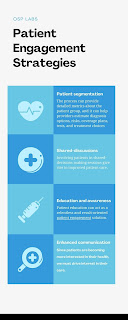
Improving patients' lives has been a core objective of healthcare from the start. Patient engagement plays an important part in this process. By involving patients in their care and treatment, the success ratio of care increases leading to healthier lives. A healthcare company needs to rely on patient engagement solutions . Some of the strategies for this will be described in this blog: Patient segmentation Identifying patients and segmenting them is an important process of providing better care. This is done by dividing the patient numbers into segments based on their conditions, ages, gender, location, and type of symptoms. The process can provide detailed metrics about the patient group, and it can help providers estimate diagnosis options, risks, coverage plans, tests, and treatment choices. When you identify your patients as a provider, you can know the population and the care it demands. Identifying patients is important as one of the best patient engagement solutions as it ...

A Step-by-step Process to Integrate Third-Party EHR Systems with Your Healthcare Solution

EHR or Electronic Healthcare Record is a digitized version of a patient’s health data and information. The process of EHR application includes extracting, managing, storing, and retrieving medical information such as history, diagnosis, allergies, lab tests, history of immunization, test reports, treatment, and so on. These also include advanced billing documentation, prescription information, and radiology images. Nowadays, EHR systems are improved and used in various aspects of healthcare. From interoperable healthcare systems to real-time data collection, it is proving to be a boon for both patients and providers. The workflow is improved using the EHR system, and the entire healthcare sector can make improved decisions. This results in enhanced medical treatments and improved health outcomes.  Why integrate EHR?  EHR integration is vital as it is the next step in digitizing healthcare for the greater good. Taking advantage of a readily accessible wide range of information,...

Pharmacy Management System - Features and Benefits

A pharmacy information system or a pharmacy management system is used in pharmacies. This system provides basic to advanced pharmacy functionality. After verification, the system can store data and have features that support safe medication delivery. Pharmacies can use this technology independently or as a larger hospital administration system module. Pharmacy management software can have a user interface, automated data entry, data retention, strong encryption for data privacy. Pharmacy management software can either be commercial off-the-shelf software or customized. Most pharmacies are turning to customized software to build custom pharmacy software system . This is because it enables pharmacies to prevent functional wastage. Pharmacies are also using cloud apps more because of their flexibility and scalability. What are some of the features of a pharmacy management system? Listed below are four significant features of the pharmacy management system. Managing prescriptions Prescript...

How Does a Provider Network Management Solution Add Value?

Image
A healthcare providers’ network is a group of doctors, and other healthcare providers like physiotherapists, home caregivers, clinics, and hospitals included in an insurance payer’s health plan. Each of those entities would have undergone an elaborate process of being onboarded into the plan. This process is called credentialing and it involves a series of verifications, processing, checks, documentation, and paperwork.  A provider network would have individual medical entities operating on a day-to-day basis, and those operations involve medical care, coding, billing, claims, and so forth. The operational efficiency of the network is of concern to the payers since they are the ones who would be footing most of the bills. It is why providers invest significant amounts of resources into healthcare provider management solutions. It used to be one of the most overlooked aspects at insurance companies. But it has undergone significant changes over the last few years as insurers have r...

Healthcare Integration

Clinical Data integration collects information from different healthcare sources into a single format. It uses components such as healthcare data sources and a master server and avoids unstructured data. The healthcare sector struggles with health integration platforms and maintaining structured data. Structured vs. unstructured data can be understood by considering the who, what, when, where, and how of the data. Integrated health provides the best quality care services to the patients. Healthcare professionals work under tremendous pressure and are pressed with time. They deal with maintaining healthcare organizations, staff, and improved patient care. Administrative tasks and advanced paper works become cumbersome for healthcare providers. Healthcare professionals struggle with unstructured data. That is why  a healthcare automation solution  is needed to bring efficiency to the managed care continuum. Healthcare integration assigns patients to different primary care physi...

Practice management solution

  Nearly every day, the healthcare industry deals with vast amounts of data of patients, healthcare personnel, and institutions which could be time-consuming and exhausting. However, manual data entry can affect the accuracy and reduce the efficiency of care services. Hence the integration of EHR systems with healthcare practice management models streamlines adding, updating, and sharing patient data online. A patient management system is frequently linked to an electronic health record system. While some data in these systems may overlap, the EHR system track patients' clinical outcomes. In contrast, the patient management system is used for administrative and financial matters such as medical claims processing in healthcare. One of the more difficult decisions for modern medical practices is connecting the two systems or purchasing an integrated software package. To promote increased operational efficiencies and comprehensive efforts like population health management systems and...

Denial management- understanding definition, types, challenges, and beyond

Claim denials are one of the prime reasons millions of dollars are lost every year. To reduce and manage denied healthcare claims, providers often look for better options in the market. However, they fail to realize that they already own the best tool- denial management .  Denial management can be integrated or availed in the facility itself, and it does not require looking for extra solutions. A strong denial policy and affirmed procedures often lead to a reduction in medical denials.  Denial management- definition The process of claim denial management is formed of two parts-first is the identification of denial, and the second is its investigation. Together, these two steps form a strong basis for the performance of denial’s root cause analysis. This also incorporates monitoring denial patterns and uncovering trends by insurance careers. As the final step, claims denial management should seek to redesign the process of the system to prevent and eliminate the risk of de...

Patient Engagement Solutions

  Patient engagement is a concept that aims to educate and enable patients to manage their own healthcare and wellness better. It does so first and foremost by improving the interaction between doctors and patients. The process of healthcare has always been about doctors talking and patients listening and following their advice. In other words, it has been unidirectional. But patient engagement in healthcare aims to change that. That is because real care happens when the patient leaves the clinic. Patients need to be better aware of the pills they consume and the treatment they will undergo. Moreover, they also need to be made aware of the condition that ails them, and how they got it. It could be because of unhealthy lifestyle choices like smoking, drinking, fast food; or it could be hereditary, or for a myriad of other reasons. Only when the patients know more about their conditions and how they contracted them in the first place, would they be in a better position to participat...

Healthcare Analytics Software

  Big data analytics is one of the hottest buzzwords in the entire data analytics industry. In simple words, big data means data sets that are too large to be assessed using conventional analysis methods. The range of big data has been moving upward over the last few years, but today, it is generally accepted that data sets in the range of a few thousand terabytes to a few exabytes can be classified as big data.    The appearance of such large chunks of data in healthcare can be attributed to the rapid pace of digitization across the industry. Additionally, medical wearables such as Apple’s smartwatch and Fitbit, in addition to smart garments, also generate real-time data about users’ vitals. Furthermore, applications for medical billing, insurance claims, and electronic medical records are all brimming with users’ medical data. Increasing digitization will only increase the size of this data.    This heap of data undoubtedly contains a ...

Healthcare Payer Analytics Solutions Improve The Overall Quality of Care

Every business in every industry runs its operations according to certain parameters. Needless to say, all of them generate operational data that holds valuable insights about various aspects of the business. As a result, data analytics has emerged as the hottest skill set that all companies, small and large, have begun looking for. Whether it is an airline, a chain of hotels, fast food joints, a shipping corporation, a software company, or even a financial services provider - every company needs data analytics. Healthcare is no different. Healthcare payers are an integral part of the overall industry. No doctor in the United States offers his or her services without knowing that he or she will be reimbursed for it by a payer. In light of such ubiquity, Provider analytics has shown great promise in helping payer organizations to streamline operations and boost productivity. Most of all, it helps insurance payers to analyze provider patterns, namely bundled payments, and evaluate costs...